Union Budget 2026: The "Viksit Bharat" Blueprint
A detailed breakdown of the 'Viksit Bharat' budget. Discover the ₹53.5 Lakh Crore roadmap, new 10% growth target, and the game-changing 'New Income Tax Act, 2025'.

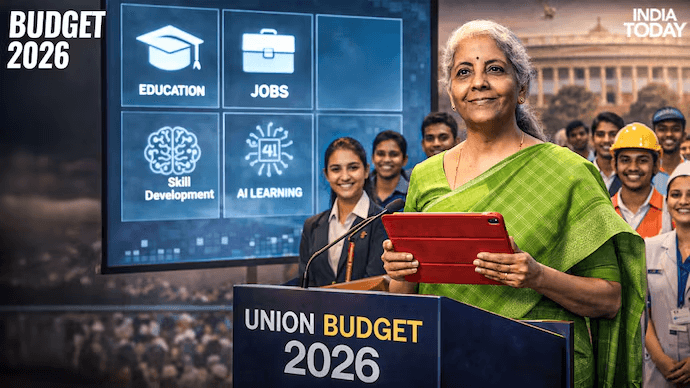
Yesterday’s budget wasn't just a financial statement; it was the first budget presented in the new Kartavya Bhawan, defined by the 'Three Kartavyas' (Duties) to the nation. With a total outlay of ₹53.5 Lakh Crore, the government is doubling down on infrastructure while pivoting toward high-tech manufacturing and biopharma. Let's decode the 'Viksit Bharat' blueprint.
Theme: Accelerating Growth
The core theme is 'Accelerating Growth, Capacity Building, and Inclusive Development'. The government has balanced aggressive growth with fiscal discipline, targeting a $5 Trillion economy.
1. The Macro-Economic Pulse
The government has walked a tightrope between growth and discipline. The fiscal deficit has been brought down to 4.3% of GDP, signaling strong macroeconomic stability. Public Capex has seen a substantial jump to ₹12.2 Lakh Crore, emphasizing that infrastructure remains the primary growth engine.
2. High-Tech & Strategic Manufacturing
India is moving from 'building digital rails' to 'powering an AI-first economy'. Two major initiatives stand out: **Biopharma SHAKTI** and **Semiconductor Mission 2.0**.
Biopharma SHAKTI Highlights
- ₹10,000 Crore outlay for biologics hub.
- 3 new National Institutes (NIPER).
- Network of 1,000 accredited clinical trials.
Semiconductor Mission 2.0
The budget doubles incentives to capture 10% of the global market. New clusters in Gujarat and UP will be game-changers.
3. Infrastructure: The 'Growth Connectors'
The focus has shifted to 'Environmentally Sustainable Corridors'. Seven new High-Speed Rail corridors, including Mumbai–Pune and Delhi–Varanasi, have been announced. Additionally, new 'Rare Earth Corridors' in Odisha and Kerala will secure critical mineral supply chains for EVs.
4. Taxation: The 'New Income Tax Act, 2025'
The biggest news for professionals is the rollout of the New Income Tax Act, 2025, effective April 1, 2026. This act promises simplified forms and a more taxpayer-friendly approach.
5. Energy Transition & MSMEs
The SHANTI Act will open up nuclear energy to private participation (100GW goal). For MSMEs, a ₹10,000 Crore Growth Fund and a new cadre of 'Corporate Mitras' will provide equity support and compliance mentorship respectively.
Green Push
Full customs duty exemption on capital goods for Lithium-Ion cells will accelerate the EV transition.
Key Takeaways for You
- Review your portfolio for high-tech manufacturing exposure.
- If you are a trader, account for higher STT costs.
- Students abroad get significant TCS relief.
- Prepare for the new simplified tax forms next year.
In Conclusion
Budget 2026 is a transition budget. It moves away from broad subsidies and toward sector-specific productivity. Whether you are a student, a techie, or a manufacturer, the message is clear: the focus is on high-value creation. The first budget from Kartavya Bhawan is a resolve to prioritize the underprivileged while strengthening India's global resilience.